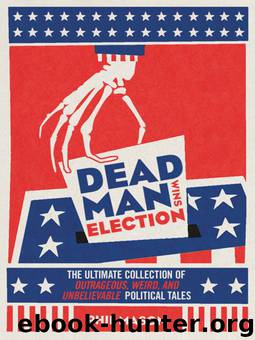
Dead Man Wins Election by Phil Mason
Author:Phil Mason
Language: eng
Format: epub
Publisher: Sourcebooks, Inc.
IN PUBLIC INTEREST
In the 1970s, the Dutch government required that all television advertisements for sweets show a toothbrush at least one-tenth the height of the screen throughout the commercial.
TO MAINTAIN THE STANDARDS expected in the upmarket Providencia neighborhood of Chile’s capital, Santiago, local municipal councilors introduced a bylaw requiring every resident of private property to keep a grass patch in the street immediately outside their front gate. In April 2002, Gloria Cisternas, a mother of four, was sentenced to seven days in jail for refusing to lay turf outside her house. She spent two days incarcerated before a public outcry over the case forced the country’s president to get involved. The conviction was later quashed.
IN THE FACE OF an increase in crime, the city council in the small U.S. town of Kennesaw, Georgia, enacted a municipal ordinance in May 1982 making ownership of a firearm compulsory for every head of household. Anyone not having a gun and ammunition faced a $200 fine and 60 days in jail. The law exempted the disabled, householders with religious objections, and, perhaps wisely, convicted felons. The law is still in force.
CITY COUNCILORS IN SANTA Monica, California, passed a bylaw in November 1991 allowing women to use men’s public toilets if the line for theirs was more than three strong, on the grounds that, as men rarely had to queue, doing so breached rights under sex discrimination legislation.
SAN FRANCISCO’S GOVERNING BODY, the Board of Supervisors, voted in May 2000 to outlaw discrimination on the grounds of size. A “fat acceptance” ordinance was passed unanimously that added to a long list of antidiscrimination measures. City laws already banned discrimination on the grounds of race, color, religion, age, ancestry, sex, sexual orientation, disability, place of birth, and gender identity (to protect transsexuals).
President of the board, Tom Ammiano, claimed the move was needed because “people are being denied employment, housing, bank loans on the grounds that they are overweight.” The new legislation decreed that “weight may not be used as a measure of health, fitness, endurance, flexibility, strength of character, or self-control.” The only employers exempted from the law were the police, fire service, and unionized strip clubs.
From now on, San Francisco’s Human Rights Commission was empowered to investigate allegations of discrimination. Among those affected by the rules were cinemas and theaters, who were required to install an adequate supply of extrawide seats, although ticket clerks were not allowed to point out their existence to ticket buyers, as that would be discriminatory.
The self-styled “fat acceptance” movement began in the city in 1999 after a health club advertising for new members ran a billboard campaign depicting an alien with the slogan, “When They Come, They’ll Eat the Fat Ones First.”
THE U.S. FEDERAL TAX Authority followed suit in 2002 by announcing that obese people could claim tax allowances in future on weight-loss expenses. The Internal Revenue Service ruled that those with medically diagnosed fat problems could deduct the costs of “mitigation, treatment or prevention” of their condition. Observers foresaw definitional
Download
This site does not store any files on its server. We only index and link to content provided by other sites. Please contact the content providers to delete copyright contents if any and email us, we'll remove relevant links or contents immediately.
| Coloring Books for Grown-Ups | Humor |
| Movies | Performing Arts |
| Pop Culture | Puzzles & Games |
| Radio | Sheet Music & Scores |
| Television | Trivia & Fun Facts |
Spell It Out by David Crystal(36123)
Professional Troublemaker by Luvvie Ajayi Jones(29673)
The Secret History by Donna Tartt(19142)
We're Going to Need More Wine by Gabrielle Union(19062)
Cat's cradle by Kurt Vonnegut(15383)
The Goal (Off-Campus #4) by Elle Kennedy(13696)
The Social Justice Warrior Handbook by Lisa De Pasquale(12199)
The Break by Marian Keyes(9380)
Crazy Rich Asians by Kevin Kwan(9304)
The remains of the day by Kazuo Ishiguro(9016)
Thirteen Reasons Why by Jay Asher(8931)
Educated by Tara Westover(8065)
The handmaid's tale by Margaret Atwood(7781)
Giovanni's Room by James Baldwin(7365)
Win Bigly by Scott Adams(7208)
This Is How You Lose Her by Junot Diaz(6903)
The Rosie Project by Graeme Simsion(6434)
Six Wakes by Mur Lafferty(6281)
The Power of Now: A Guide to Spiritual Enlightenment by Eckhart Tolle(5804)
